Delta Gammas seek to do good every day! We pledged to do so when we accepted our bids to Delta Gamma. Our Fraternity letters were chosen in 1873 because they represent our motto and desire to do good.
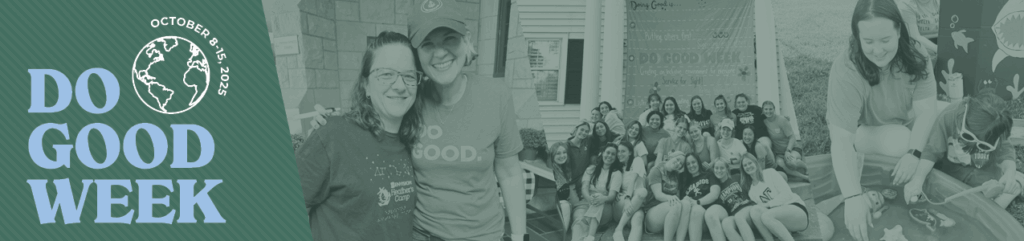
During the week of October 8-15, Delta Gamma invites you to participate in our twelfth annual Do Good Week by doing good deeds, no matter how big or small. Anyone can participate, whether you are a sister, fraternal partner, friend, neighbor or simply a kind person hoping to make the world a little better.
Do Good Week coincides with World Sight Day (October 9) and White Cane Day (October 15). Take advantage of this opportunity to learn, do and advocate for Service for Sight. Learn and raise awareness about vision-related topics and consider organizing a group-wide service event or doing something on your own. Resources can be found below.
Download Do Good Week Graphics Here
Service for Sight activities (for individuals and groups)
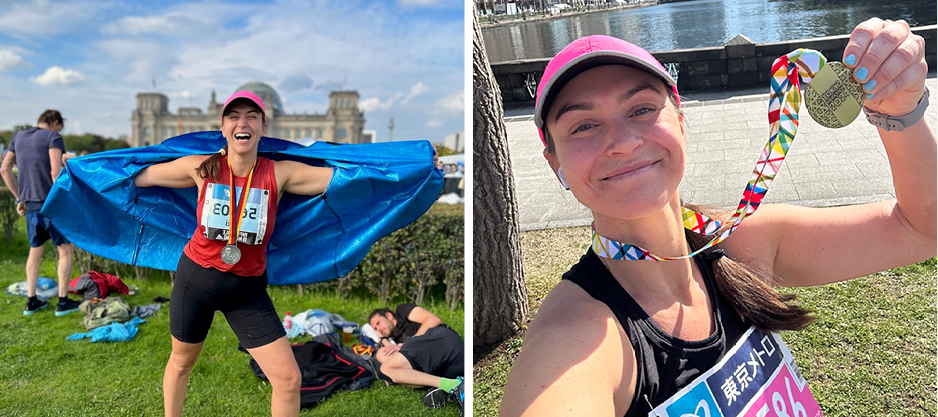
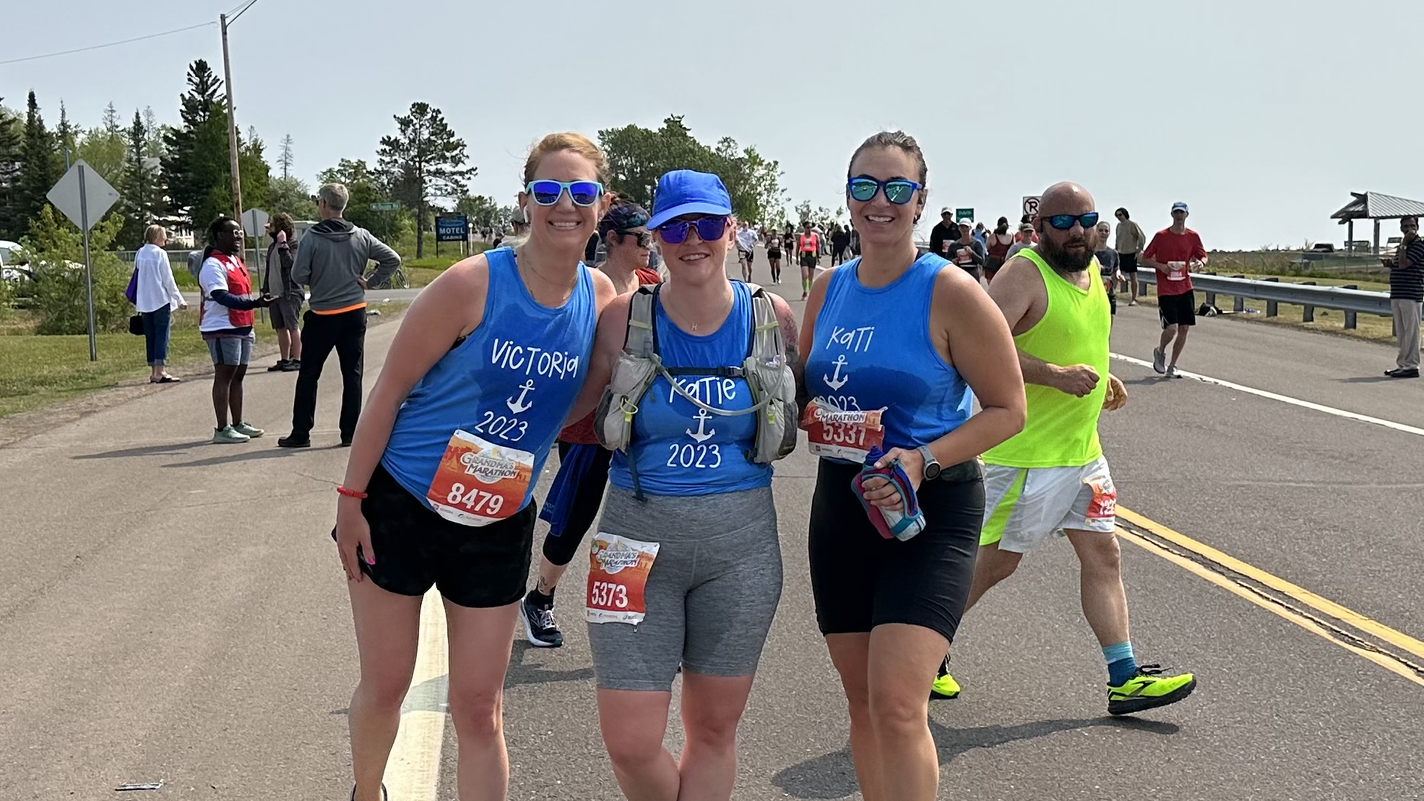
Kati Fratesi, Delta Kappa-South Florida, has dedicated the past 16 years to supporting Delta Gamma’s Service for Sight philanthropy. During her undergraduate years, she dedicated over 40 hours per year to various causes, including the Lighthouse for the Blind, Lions Eye Institute, Southeastern Guide Dogs and other local organizations.
After graduating from the University of South Florida, Kati worked as a Collegiate Development Consultant (CDC), traveling across North America to support Delta Gamma’s collegiate chapters. In this role, she prioritized cultivating a philanthropic spirit by fundraising for and increasing awareness of Service for Sight.
Kati discovered her love for running during her senior year of college when her roommate encouraged her to sign up for a half marathon. “Since that first race, I was hooked!” she said. During her time as a consultant, she even shared her passion for running by going on runs with collegians.
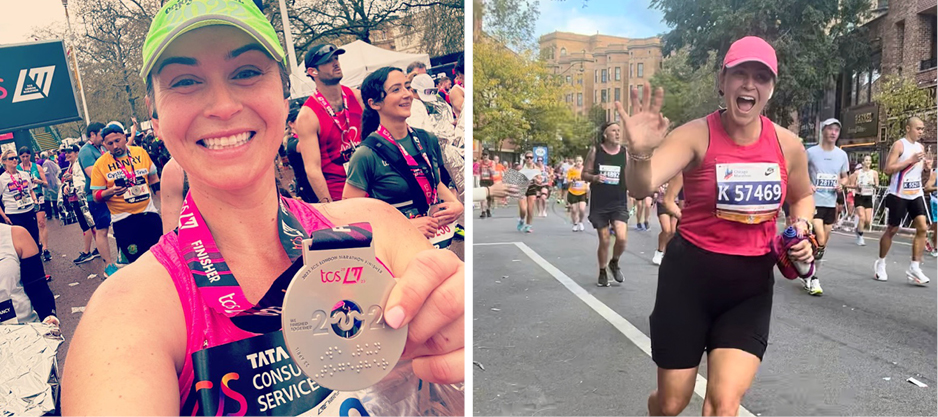
After moving to Chicago, Kati participated in her first marathon, the 2015 Bank of America Chicago Marathon. The experience ignited her passion for long-distance running, and she has since completed 12 marathons, including five of the six Abbott World Marathon Majors. On April 21, 2025, she will compete in the Boston Marathon to earn her Six Star Medal.
Kati is not only running the Boston Marathon – she is also making an impact while doing so. She is a member of Team With A Vision’s Boston Marathon charity team, raising funds to support the Massachusetts Association for the Blind and Visually Impaired (MABVI).
For 30 years, Team With A Vision has increased awareness and raised essential funds for MABVI. The international team of runners, both blind and sighted, races to spread the message that with the right support, anything is possible.
Reflecting on her journey, Kati said, “Running the Boston Marathon while representing MABVI’s Team With A Vision is a culmination of my marathon journey and my passion for supporting the blind and low-vision community. Combining my love for running with my advocacy feels like the ultimate privilege, and I can’t wait to cross the finish line, earning both my sixth star and the chance to give back in a meaningful way.”
The founding of the first Delta Gamma School, Blind Children’s Center, in 1938 was the result of the request by Ruth Billow, Eta-Akron, to make sight-related initiatives our official philanthropy. Since then, Delta Gammas have passionately supported children living with blindness through hands-on service, school board leadership, fundraising and Foundation Service for Sight grants. Here are the latest updates from the five Delta Gamma Schools for Children with Visual Impairments, along with how each of the schools put their Delta Gamma Foundation Service for Sight grant funds to good use.
Founded in 1982 by the Denver alumnae chapter and Colorado Library for the Blind.

Over four decades ago, a small group of visionary Delta Gamma alumnae in Denver set out to create a safe haven for young children who were blind or had low vision. Today, that vision has grown into the Anchor Center — offering education, intervention and specialized support for students with low or no vision, with a focus on the formative years — birth to age five.
In a unique partnership, Anchor Center’s state-of-the-art eye clinic brings pediatric ophthalmology faculty and physicians from the University of Colorado, Children’s Hospital Colorado and private practice on-site for exams and treatment. It’s a familiar and comfortable environment for the children and their families, and it enables their teachers to participate in the treatment, too.
Additionally, Anchor Center is emerging as a national leader in pioneering research, early diagnosis and treatment of Cerebral/Cortical Visual Impairment (CVI), a brain-based neurological condition affecting the brain’s ability to accurately interpret visual stimuli. CVI is the leading cause of pediatric visual impairment in the developed world.
Together with its Children’s Hospital partners, Anchor Center is researching the use of a non-invasive screening tool to assess neurological risk for CVI in premature infants who are particularly vulnerable to brain-based visual impairment. The goal is to diagnose and provide targeted intervention to CVI patients as early as possible, during the critical period when the brain-eye connection is developing. As part of this important work, Anchor Center staff has trained hundreds of hospital staff and early interventionists nationwide on the innovative assessment protocol.
“Anchor Center is incredibly thankful to DGs and the Delta Gamma Foundation for their long-standing volunteer and financial support,” said Anchor Center Executive Director Meghan Klassen. “It’s an honor and privilege for our team to be able to bring to life the DG commitment to do good every day.”
2023-24 Service for Sight Grant: The grant was used to help fund the Cortical/Cerebral Visual Impairment (CVI) Program for young children offering specialized screening, assessment, research, and training for parents, caregivers and H/C professionals.
Website | Facebook | Instagram | LinkedIn
Founded in 1938 by the Los Angeles alumnae groups and Dr. Lillian Ray Titcomb, Upsilon-Stanford.

Last fall, BCC celebrated its grand reopening, marking a new chapter in its inspiring history of supporting visually impaired children. New specialized classrooms are designed to the tailored educational approach at BCC. One room, dedicated to preschoolers, is fully accessible, ensuring every child has a safe, welcoming place to learn and includes a calming corner for students to express and manage their emotions. Another room is stocked with specialized tools to help students engage with their environments in a sensory-rich, supportive setting.
“We have always been committed to providing an inclusive space where children of all abilities can learn, grow and thrive,” said BCC Executive Director Sarah Orth, Delta Phi-UC Irvine. “This renovation strengthens our ability to fulfill that mission and we look forward to witnessing its positive impact on our students, families and the broader community.”

Delta Gamma collegians in the Los Angeles area have played a vital role in supporting BCC for many years, and their dedication continues to make a meaningful impact. Through hands-on volunteer work, fundraising efforts and advocacy, these passionate sisters contribute their time and resources to enhance the lives of the students and their families.
Last June, the Delta Gamma Hope Serving program was held at BCC. Alumnae and collegians spent a week engaging in hands-on service at the Center and helped students and teachers in their classrooms.
The Los Angeles community has recently experienced significant devastation due to the wildfires, impacting families, homes and local institutions. Despite these challenges, the school has successfully reopened, and air quality conditions have improved, allowing students and staff to return to a sense of normalcy as the community begins to rebuild.
2023-24 Service for Sight Grant: The grant was used to support the BCC’s Zero to Three Program, focused on building critical skills in daily literacy, mobility and motor skills training in an inclusive classroom.
Website | Facebook | Instagram | LinkedIn
Founded in 1951 by the St. Louis alumnae chapter.

DGC fulfills its mission by empowering children who are blind or have low vision to reach their full potential through family-centered, specialized services and strong community support.
This past fall, DGC welcomed students and families to their annual DGCKids All-Family event at a local farm and greenhouse. Collegians from Eta Theta-St. Louis spent the day volunteering at the event and helped kids enjoy pumpkin decorating and a petting zoo.
Gamma Iota-DePauw also did good at DGC last fall by helping assemble over 1,300 packets for the vision screening program. The packets will be distributed to families after their free vision screenings.
DGC kicked off the new year with their January GRADS (Group Recreation and Developmental Support) event at the Center. Through monthly group meet-ups, special events, and outdoor adventures, GRADS helps children practice orientation and mobility, socialization, and life skills in a fun, engaging environment. The January event included a visit from Champ Assistance Dogs and a goalball lesson from MindsEye Adaptive Athletics.
2023-24 Service for Sight Grant: The grant was used to help fund the Early Intervention Program, which provides specialized health, educational, developmental, and support services for infants and toddlers with low vision.
Website | Facebook | Instagram | LinkedIn
Founded in 1952 with the Greater Kansas City alumnae chapter being a founding partner.

CCVI’s mission to help children reach their highest potential in the sighted world starts with a comprehensive model that includes vision screening, early interventions, a preschool, Early Learning Academy and specialized physical and occupational therapies, like speech-language, orientation and mobility to meet the multiple disabilities and challenges many students face.
In October, CCVI celebrated the tool of independence in a new way, with its first-ever White Cane Safety Day community celebration. CCVI hosted a White Cane Walk-A-Thon followed by crafts, food, face painting, and a concert. There was no shortage of Delta Gamma sisters at the event helping hand out lunch and cheering the students on.
2023-24 Service for Sight Grant: The grant was used to support the delivery of therapeutic and specialized services to children with blindness or low vision, ensuring that each child receives intervention tailored to their needs.
Website | Facebook | Instagram | LinkedIn
Founded in 1952 by parents of children who were blind and designated a Delta Gamma School in 2018.

Over the past 72 years, FBC has gone from serving four students in a family living room to being an essential resource for over 2,000 people across Arizona. FBC has always aspired to do more to help more people. And while there is always work to be done, FBC’s new five-year strategic plan focuses on ensuring that every person with a visual impairment in Arizona has access to the resources, tools and services they need to thrive. This is the organization’s new guiding principle and will be spearheaded by FBC's new Chief Executive Officer, Jared Kittelson. He says, “FBC is about hope. It’s about what’s possible.”
Earlier this month, the Delta Gamma Hope Serving program visited FBC for a week of doing good. Four alumnae and six collegians worked hands on with students and learned all about the school. One of the participants, Kaisha, Zeta Eta-Texas State, reflected on her week at FBC: “This experience is expanding my views on the limitless possibilities for people with visual impairments and has forever changed how I will interact with people with a disability in the future."
2023-24 Service for Sight Grant: The grant was used to support FBC’s Early Intervention Program, providing year-round home visits for children from birth to age 3 and preschool for ages 3-5. Funding will go toward staff training and supplies.

Delta Gammas seek to do good every day! We pledged to do so when we accepted our bids to Delta Gamma. Our Fraternity letters were chosen in 1873 because they represent our motto and desire to do good.
During the week of October 9-16, Delta Gamma invites you to participate in our eleventh annual Do Good Week by doing good deeds, no matter how big or small. Anyone can participate, whether you are a sister, fraternal partner, friend, neighbor or simply a kind person hoping to make the world a little better.
This year, Do Good Week coincides with World Sight Day (October 10) and White Cane Day (October 15). Take advantage of this opportunity to learn, do and advocate for Service for Sight. Learn and raise awareness about vision-related topics and consider organizing a group-wide service event or doing something on your own. Resources can be found below.
Download Do Good Week Graphics Here
Service for Sight activities (for individuals and chapters)
By Janet Bergeron Vidrine, Gamma Zeta-Louisiana State
Raising a puppy to one day become a guide dog involves a lot of work from applications to training, but the result is worth the time and effort. In November 2023, Guide Dogs for the Blind gave a presentation at Gamma Phi-Arizona State about becoming guide dog raisers and puppy sitters. Many members were interested in participating in the program and filled out interest indicators which included answering questions about availability, current schedules in school, majors and GPA information. The chapter president met with Sandy and Becky from Guide Dogs for the Blind to help them find raisers in the chapter. They reviewed the applications and based on the information provided determined which members were qualified and able to raise dogs. Many chapter members were selected to be puppy raisers and puppy sitters.
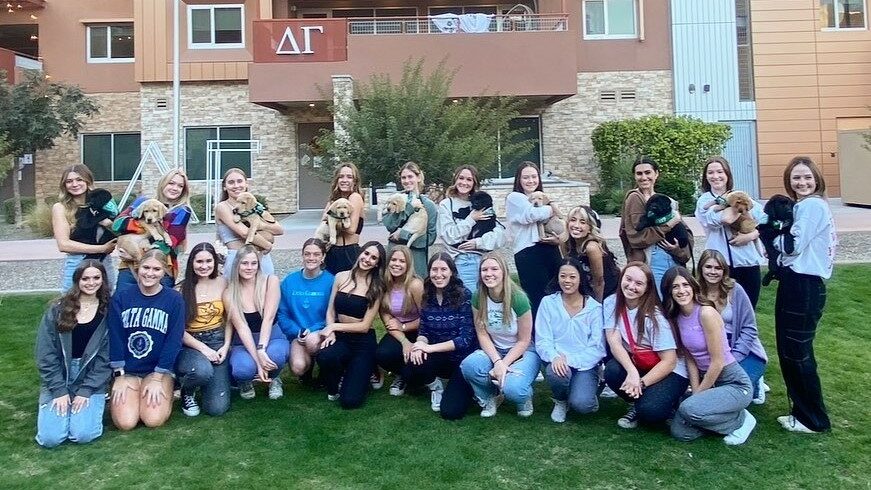
Once selected, the future raisers and babysitters attended an all-day training session where they learned all they needed to know about raising the puppy and the expectations. They also had practice with real guide dogs to get some first-hand experience with handling. Next came the home evaluations to make sure the raiser had the necessary space to raise a dog.
Caroline McGuire, Gamma Phi-Arizona State, co-raised Otto with another DG sister, Sophia Busch Isaksen, in their shared apartment for the first 10 months. When school started back up in August, Caroline moved into the chapter house and Otto split his time up between living in the house and with Sophia in her apartment. Every moment was an opportunity for Otto to learn and train, whether it was walking on the busy streets of Tempe or being able to sit and settle well during large sorority functions, Otto was always learning.
When Otto lived in the chapter house, he experienced living with 30 women. Several members in the house were also puppy sitters, so their knowledge of how to handle Otto came in handy. Through several presentations, the entire chapter learned everything about puppy etiquette to help them understand that these puppies were not your average dogs and that you could not treat them as such.
Some etiquette tips they learned included not talking to the puppies in a baby voice, always approaching the handler first and asking permission to pet, and to not distract the dog or touch them when they had their green vest on. It took some time for the members to remember all the rules, but they did learn and even helped teach others in the community these rules as well. Overall, the entire chapter had a very positive response to having the dogs at DG events and in the house, and everyone grew to love all the puppies. During family weekend members would show off their composites to their families and point out the guide dogs who had their own featured pictures.
Saying goodbye was difficult not only for the raisers but for all the members of the chapter. All the women living in the house got attached to Otto. They threw him a puppy graduation party where he got to “come” and get his diploma of kibble. All the women got a chance to take pictures with Otto in his graduation cap and say their goodbyes to him.

Flying Otto out to Oregon was very emotional for both Sophia and Caroline, but they were so proud of how far Otto had come and how well he did during his training. He did well through all the phases and made it to phase eight before they got news of his “career change.” Unfortunately, Otto was not going to be a guide dog due to some body sensitivity issues. He is now in New Jersey waiting for his next assignment.
In Caroline’s words, “Getting to raise Otto for my junior and senior year of college was the best decision I have ever made, and I would not change anything.”
If any chapter members are interested in raising a guide dog, please reach out to one of the many organizations looking for raisers. Members can live in Delta Gamma facilities while raising a puppy. Check the Delta Gamma Website Library for the housing waiver information that would need to be completed before becoming a puppy raiser.
Delta Gammas do incredible things every day – whether in their careers, through volunteer work, or just by being awesome humans. To celebrate our members and tell their inspiring stories, the Member of Impact recognition program selects honorees on a quarterly basis. We are excited to share the first recipients of the Member of Impact recognition program.
To nominate a sister for next quarter, click here.
For questions or more information, please contact Fraternity Director: Alumnae Engagement, Dr. Melissa Thompson, Gamma Zeta-Louisiana State, at engagement@deltagamma.org.


Christy Carter, Delta Nu-Northern Illinois, and member of Chicago West Suburban alumnae chapter, is a part of a unique program hosted by Northwestern University called Northwestern Prison Education Program. It is the only bachelor's degree-granting program for incarcerated students offered by a top ten university. Christy was selected to serve as an educator for the program and spent 16 weeks in Stateville Prison teaching speech communication and public speaking. According to Christy, the program and her involvement were truly transformative. “This program not only reduces recidivism but it also creates hope and provides the students with meaningful opportunities.” After they graduate, Christy often writes recommendation letters or character references for her former students to assist their legal teams with reducing their sentences.

Raquel dos Santos, Eta Zeta-Chicago, is majoring in biological sciences with a specialization in genetics, minor in health and society, and plans to attend medical school after graduation. While in college, her philanthropy work in Delta Gamma inspired her to keep “doing good” by co-founding a student-run nonprofit organization called Scientella. The organization seeks to promote greater youth, female, and minority involvement in STEM fields by matching students with real-world career discovery experiences, impact-minded leadership development opportunities, and scholarships. To date, Scientella has impacted more than 500 middle and high school girls, completed more than 900 matches, engaged more than 60 professionals, raised $150,000 in donations and holds 15 active high school chapters globally. Raquel’s hope is that “by immersing young girls in these opportunities, they are empowered to pursue fields that desperately require increased female representation in order to shape an inclusive and diverse future of science for the better, ultimately equipping them to “do good” in all aspects of their lives.”
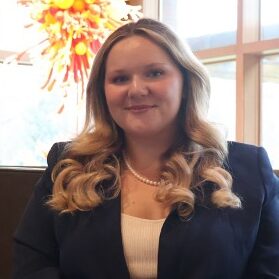
Sueli Gwiazdowski, Alpha Eta-Whitman, calls on her experiences as a Disabled, first-gen working-class, Latina, queer student to affect change across her campus. She is the founder and president of Whitman College’s first-ever Disability Affinity Group, called DISCO and has dedicated each summer of her college career to public service. Sueli spent one year as a law fellow at the Coelho Center for Disability Law, Policy, & Innovation at Loyola Law School and was awarded the 2022 Huemann-Armstrong Award recognizing her advocacy work. Her nominator, Marleigh Anderson, Alpha Eta-Whitman, says of Sueli’s work on campus, especially her working to make their chapter room wheelchair accessible, “she makes our campus, our Fraternity, and the world a better place.” In her term as chapter president, Sueli successfully advocated for the purchase of an off-campus property that will be the first off-campus home for panhellenic women in Whitman College’s history. It is set to open in fall 2024, and thanks to Sueli’s advocacy work, it is wheelchair accessible.

Laura Rudge Peterson, Gamma Epsilon-Kent State, and member of Atlanta alumnae chapter, is a natural interviewer and storyteller. Recently, she has become involved with StoryCorps, a national nonprofit with a mission to help us believe in each other by illuminating the humanity and possibility in us all — one story at a time. Laura, with the help of fellow alumna Carol Harman, Delta Iota-Georgia, chooses people (most are Delta Gamma alumnae so far) and records their stories, shining a light on their contributions to Delta Gamma and beyond. Once published with StoryCorps, the stories are then stored in the Library of Congress. Her nominator, Joanna Shook, Alpha Upsilon-Southern Methodist, says of Laura, “her ability to connect with people of all ages, to get them to talk about themselves and shine a light of love and recognition has been truly remarkable. Even if someone doesn't believe they have anything special to offer, by Laura having them share their story, she is showing them that they do.” Laura is an incredible champion for people who otherwise might not be heard.
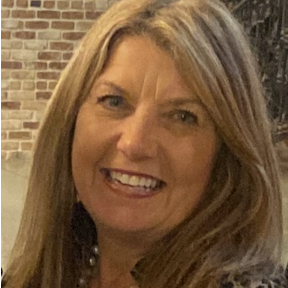
Dana Rivera, Gamma Zeta-Louisiana State, and member of Acadiana alumnae association, spearheaded a family fundraising effort to benefit St. Jude’s Children’s Research Hospital in honor of her late son Parker, who died in 2015 at age 15. After his cancer diagnosis, she established Team Parker, an organization that has raised more than $300,000 through local fundraisers in the Lafayette, Louisiana, area in the last ten years. While supporting the place and people who gave their family extra time with Parker, she also is a force for good by volunteering for the American Cancer Society, Junior League, Faith House, and Festival International, among many others. Outside of her volunteer work, she was also named Teacher of the Year at Broadmoor Elementary.

Britt Royal, Alpha Epsilon-Washington, and member of Saint Louis Area alumnae chapter, grew up reading cookbooks and spending time in the kitchen baking for others. Used as both a stress reliever and a creative outlet, she jumped at the chance to open her own bakery. Having been diagnosed as gluten intolerant 12 years ago, she wanted her bakery to focus on menu transparency, an open-kitchen concept, and a contamination-free environment. In her own words, “We all deserve good cake,” and this motto is a driving force behind her successful business, necessitating expansions in both staff and offerings. For people with dietary restrictions, intolerances or allergies, her bakery is more than just a sweet treat. It is a place where they feel safe and accepted.

Jennifer Surgalski, Zeta Sigma-Northern Kentucky, and member of Dallas alumnae chapter, is living our do good motto. As veteran leader for the NFL’s Dallas Cowboys, Jennifer has been at the forefront of some of the most innovative business partnerships and strategic projects within the sports industry. Among those include her contributions to the National Medal of Honor Museum Foundation, working to preserve the legacies of Medal of Honor recipients, those who have received our nation’s high recognition for valor in combat while defending our freedoms. What began in a volunteer capacity led to the Foundation naming her Chief of Strategy, where she passionately contributes business expertise to its key initiatives – opening a national museum in Texas, establishing a monument in Washington, D.C., and creating a leadership institute promoting the values of courage and sacrifice, commitment and integrity, and patriotism and citizenship for generations to come. Her nominator, Leslie Dorris, Zeta Sigma-Northern Kentucky, says of Jennifer, “She is a true advocate for Medal of Honor recipients and the values they exemplified while bravely serving our nation.” You can learn more about the difference she is making in the areas of branding, business strategy, fundraising, museum design, and milestone events by following her work on LinkedIn.

We are proud to partner with another Delta Gamma School for Children with Visual Impairments for this Hope Serving program! Participants will travel to Los Angeles, California, June 9-15, for a week of hands-on service at the Blind Children's Center. The Blind Children's Center prepares infants, toddlers and preschoolers of all abilities to thrive through inclusive, family-focused early childhood education, with a specialized focus on children who are blind or visually impaired.
Hope Serving is a service-learning experience that offers Delta Gammas the opportunity to develop as leaders on a local, regional and international level and encourages learning and critical thinking through hands-on service, community involvement, and civic and social justice education.
The Hope Serving program is open to all initiated Delta Gammas in good standing. Both alumnae and collegians are encouraged to apply. Apply by March 10, 2024. Late applications may not be accepted.
Participant selection criteria are:
Please note that you may be required to have a valid passport, complete a background check and/or fill out additional paperwork.
We hold high expectations for participants and ask them to have high expectations for themselves. If selected, you will be part of a group of Delta Gammas who will have the opportunity to participate in a remarkable service experience. Applicants should consider the following when applying:
As a result of the Hope Serving experience, each participant will be able to:
After successful completion of this program, participants will serve as Hope Serving Ambassadors and are expected to share their experiences with other Delta Gamma members. This includes delivering a presentation to their collegiate or alumnae chapter, and in-person or virtual presentations to their Regional Team and other chapters in the region (to be determined based on final participants).
All participants will receive 50 Do Good Service for Sight hours for completing the program.
The cost of the program, including travel, will be covered by Delta Gamma Fraternity and Delta Gamma Foundation. Any airfare and lodging will be paid for directly by Delta Gamma. Other items such as baggage fees, meals while traveling, etc. may be required to be paid for upfront by participants and subsequently reimbursed by Delta Gamma. Participants will be responsible for securing their own medical insurance coverage. Participants will also be responsible for any additional costs and expenses not covered by the program (including but not limited to snacks not covered by the Hope Serving program, social outings/gatherings, gifts, clothes, lost luggage, etc.).
Fees will be assessed if a participant resigns from the experience. See Cancellation Fee section below for additional details.
Due to limited space and funding, should a participant cancel after accepting a spot the cost of the trip, approximately $1,800, will be assessed back to the participant. The cause of cancellation shall be considered in determining the need for assessment. No replacements will be permitted.
See the Travel and Event Policy for more information regarding attendance, transportation and cancellations. The Travel and Event Policy applies to this event.
Hope Serving participants are expected to adhere to all state, local and service site health and safety guidelines. This may include wearing a mask while at the service site, providing proof of COVID-19 vaccination and/or providing proof of a negative COVID-19 test prior to the trip. Further details will be provided during the interview process.
Questions?
Please contact Learning and Engagement Specialist Dylan Rowell at dylan.rowell@deltagamma.org.

This is the story of Ed and Sully, a perfect partnership that was made possible by a Service for Sight grant from the Delta Gamma Foundation to Southeastern Guide Dogs. Ed and Sully are an inspiring pair and are proud to share their story with you.
Ed Burton is a U.S. Navy veteran and operating engineer mechanic, who was unable to continue serving due to vision loss. Having lost his sense of purpose in a sighted world, Ed felt adrift and isolated. But Sully, a four-legged firecracker full of energy, nicknamed his "Alfa Romeo sports car" wouldn’t let Ed give up. Now, these two are living life to the fullest, side by side, ready for any adventure.
Before receiving his first guide dog, Ed was using only a cane. Although the U.S. Department of Veterans Affairs kept telling Ed he should consider getting a guide dog to aid mobility and independence, Ed was not interested at the time. For the most part, he managed to get around without too much trouble, except one day when he crossed the street while jogging with his cane. He didn’t hear anyone coming, so he proceeded into the crosswalk. A car quickly approached and turned right without stopping and hit him on his left side. It became apparent to Ed that he needed a guide dog as a result of the accident.
The process of being matched with a guide dog is extensive. The applicant completes a detailed questionnaire and phone screening about their lifestyle, where they live, what they like to do, and anything else that might help them find their perfect partner. The puppy raisers also take notes about the dogs they are raising through the process. Using all the information collected, the center determines which dog will best suit the recipient. There is typically a backup dog in case the first match doesn’t work – sometimes it is just a matter of trial and error.
For Ed, once he was matched with Sully, he attended a puppy boot camp for 26 days where he lived on campus and learned how to work with his new companion. His favorite moments with Sully during that first month were recalled by Ed: “My favorite part of the training was about the second week in, as you’re bonding. I was with Sully and told her to sit and stay with the trainers. They then took me and sat me down in a chair in a different section of the hallway and I called to her. She came running and launched herself and hit me in the chest.”
Now, one year later, Ed is living an independent life. He is passionate about sharing his story and how receiving a guide dog changed his life. “I trust my life with this dog. She keeps me from falling into holes, running into tree limbs, and so much more. She has literally saved my life twice. It’s amazing the work they do. And the dogs just seem to know who needs them.”
And the story gets even sweeter – Sully’s puppy-raiser is a Delta Gamma! Cheryl Hoffman Zsido Poage, Gamma Upsilon-Wichita State, was integral in Sully’s fundamental training, bringing this do good story full circle.


Cheryl shared, “I began raising puppies for Southeastern Guide Dogs in 2015 as a part of a service learning project with my students. I have raised six puppies for Southeastern Guide Dogs, including Sully. We received Sully at 8 weeks old, and we worked with her until she was 18 months old. As a puppy-raiser, we are responsible for teaching our pups basic cues and socialization, and Southeastern Guide Dogs provides the puppy raisers with all the resources needed to successfully raise the pups. Once the puppy reaches anywhere from 14-18 months they are called back to Southeastern Guide Dogs to begin formal training. This is done by professional trainers, and this is where the puppies begin training for various careers, including Guide Dogs, Veteran Service Dogs or a handful of other careers. Once the puppy graduates, the match process begins, and the puppy will be placed with its handler.
Sully was a fun pup to raise. She was very smart and loved to work. When she saw her coat, she knew it was time to go out and practice her cues — nothing made her happier than that. When she was off work, she was a silly girl just like any other lab puppy you might meet. My favorite things about raising Sully were her can-do attitude and confidence. She was always up for the next challenge whether it was canine fitness, working on distractions, or fine-tuning basic cues. When we turned Sully back over to Southeastern Guide Dogs, she never once looked back. It was almost as if she was saying, ‘I’ve got this!’”


Southeastern Guide Dogs reaches a variety of people in need and offers guide dogs to adults and teens with vision loss, as well as service dogs to veterans with PTSD and other disabilities, all at no charge to the recipient. They also provide skilled companion dogs, facility therapy dogs and Gold Star Family Dogs to individuals and families facing emotional hardships, such as depression or the loss of a loved one in the military. If you are interested in becoming a puppy raiser or would like more information on the services Southeastern Guide Dogs provides, please visit www.guidedogs.org.
The Delta Gamma Foundation is committed to supporting organizations that share our mission of Service for Sight. In the 2021-2022 fiscal year, the Foundation awarded 63 Service for Sight grants totaling $400,000 to national organizations to fund programs benefiting people living with blindness or low vision.

By Emma Mathews, Epsilon-Ohio State
In light of World Sight Day on October 14, Delta Gamma honors our philanthropy, Service for Sight, as well as our sisters that dedicate their time supporting it. The women of the Gamma Upsilon-Wichita State spend their time volunteering at a local organization called Envision, which has locations in Wichita, Kansas and Dallas, Texas. Envision is a non-profit that works with the blind and visually impaired. According to Envision’s website, their mission is “to improve the quality of life and provide inspiration and opportunity for people who are blind or visually impaired through employment, outreach, rehabilitation, education and research.”
Paeten Howard, the vp: communications for Gamma Upsilon-Wichita State, said the chapter does a majority of their Service for Sight with Envision. She describes the chapter to be very hands on and expresses their gratitude to be able to have such a close relationship with an incredible local organization. After spending so much time at Envision, they even initiated an employee from the organization because they became so acquainted and felt as though she embodies everything that it means to be a Delta Gamma.

Members of the chapter attend a weekly Envision youth art club that encourages young and visually impaired students to express themselves through art. Additionally, many women from the chapter have previously volunteered at Envision Pride. Paeten describes Pride as an event that works with blind and visually impaired adults who also have intellectual disabilities. At the event, they make music, play with hair and fun styles, participate in games and so much more.
The list goes on of the service that these amazing women have dedicated themselves to. Past Envision events Gamma Upsilon has attended includes an event at the local zoo in Wichita and a back-to-school bash that Envision hosted at a community park. Most recently, Envision held their yearly gala which Delta Gamma women helping set-up, assist during the event and aid in cleanup. Coming up soon, the Gamma Upsilon chapter has a large Fall Festival event planned with the Envision youth which will be held at a local pumpkin patch.
On top of their time spent at Envision, Gamma Upsilon does much more to support our philanthropy. They host a Pancake Feed Fundraiser every fall to raise money for Envision and the Delta Gamma Foundation. In addition, they host their synchronized swimming competition, Anchor Splash®, in the spring which allows other Greek houses on the Wichita State campus to team together and raise money for Service for Sight. Prior to the pandemic, the Gamma Upsilon women also volunteered at Via Christi Villages, a local independent and assisted living community. Although it has been difficult to visit Via Christi Villages in recent times, the women have still found ways to volunteer their time such as making Valentines Day or fall themed wreaths for the community.

Megan Kelly, Gamma Upsilon-Wichita State, said, “her favorite part about volunteering at Envision’s art club is seeing the kids have fun, and making connections with them.” Paeten describes that each child she has met at art club “is so positive and excited to be there. All that they wish to do is make new friends, give big hugs and make art with the visitors.”
In coordination with World Sight Day and White Cane Awareness Day, the Delta Gamma Foundation is celebrating October 10-16 as the second annual World Sight Awareness Week. This week is meant to highlight our philanthropy, Service for Sight, raise awareness around sight preservation and share ways you can advocate for the blind and visually impaired community. Check out the information that was shared to the Foundation Facebook and Instagram accounts.

Delta Gammas across the globe has once again showed we are a force for good! This year’s eighth annual Do Good Week rendered participants who showed their support for individuals and communities. Activities ranged from donating items to a charitable organization, collecting supplies for those affected by Hurricane Ida, spending the day at the local food bank and writing cards to loved ones. Check out these groups who came together to represent Delta Gamma during Do Good Week!

Alumnae from the South Orange County alumnae group volunteered at the Makapo Aquatics Project to help organize their storage shed.