Let’s Spell it Together: S-E-S-Q-U-I-C-E-N-T-E-N-N-I-A-L
By Staige Davis Hodges, Beta Theta-Duke
Since 1881, Delta Gammas have gathered at Convention with the purpose of accomplishing the business of the Fraternity and shaping its future direction. Sigma-Northwestern collegians summarized their 1902 Convention attendance aptly: “Perhaps the best lesson that Convention teaches us all ... is to work not only for the good of our individual chapters but also for the good of our Fraternity as a whole.” Days and evenings are punctuated by banquets, speeches, the sweet melody of Delta Gamma songs and reveling in sisterhood.

Convention has been held every two years, for the most part, since 1881 when only two chapters met: Psi I-Lewis School and Eta-Buchtel (Akron). Convention was deferred in 1917 due to World War I, as President Woodrow Wilson requested organizations contemplating conventions “abandon them for patriotic reasons” to save the expense and decrease railroad congestion. The $1,000 of the unused Convention fund was appropriated for war relief work. Convention would only be canceled one other time: in 1944 due to World War II.
The goal for the Fiftieth Anniversary Convention in Estes Park, Colorado, in 1924, was to “make it be the biggest and the best Convention we have ever had.” The Fraternity developed a scholarship “Birthday Fund,” which reached over $57,000, well beyond the aforethought-lofty goal of $50,000.


In 1948, the Diamond Jubilee Convention was held in Swampscott, Massachusetts. Each chapter provided a doll – a “Dream Girl” dressed in the fashion of the era in which the chapter was chartered. Attendees could tour the nearby L. G. Balfour Company to see how anchor badges were made.
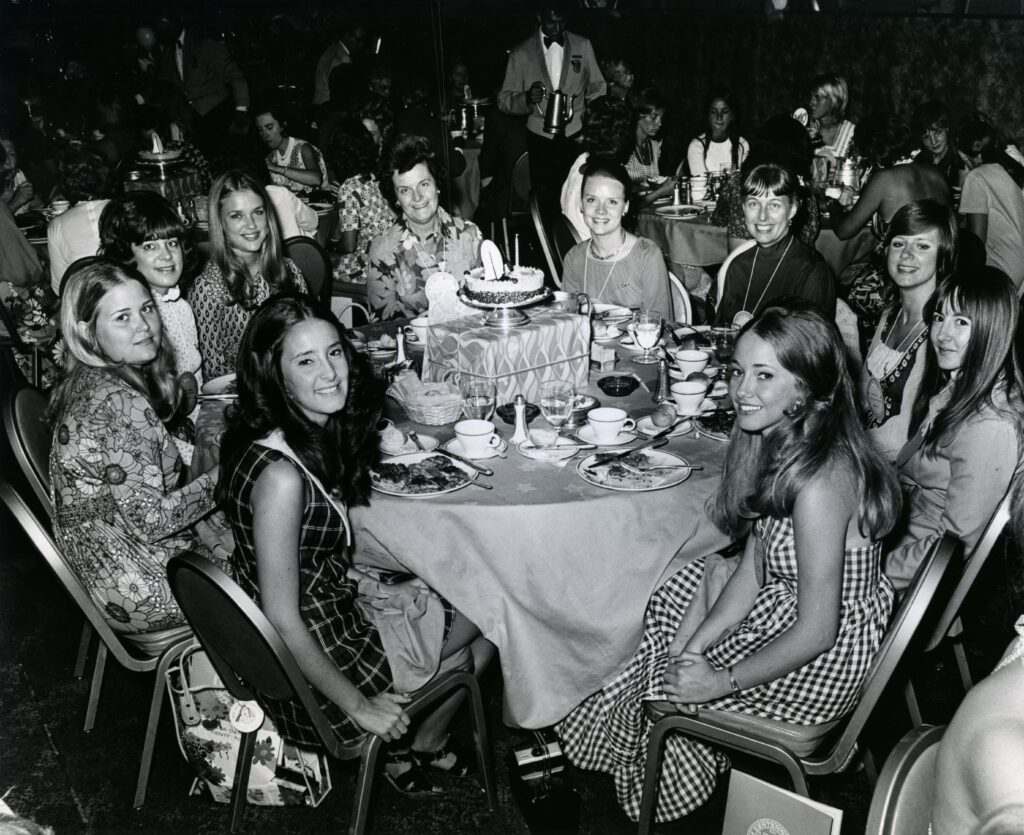
Our grand Centennial was celebrated at the 1972 Convention in Los Angeles, California. Attendance was so high, that collegiate visitors were provided rooms at the local Alpha Nu-USC and Alpha Sigma-UCLA chapter houses and then bussed to and from Convention daily. Each collegiate chapter designed and made a fabric quilt square to create a commemorative centennial quilt, which now hangs in the Archives. Vicki Vannoy Nixon, Gamma Xi-Texas Tech, was at her first (of many) Conventions. She recalls, “One of the most memorable moments was when a bus loaded with Delta Gammas leaving the Convention suddenly realized that the band The Monkees ... was staying at the hotel. They walked by our bus to hoots and hollers and DGs calling out the names of their favorite artist!” Vicki, who later went on to serve on Council, is seated at the table at the front left in the banquet photo. She says about Council members she met, “I set my goal to be on Council one day after being exposed to these women. I guess it worked!”
By 1998, a Convention planner was on staff at Executive Offices to work with the host city and alumnae committee. Atlanta, Georgia, provided a hospitable welcome for the 125th.
Now the word that no one can easily pronounce: sesquicentennial. Since 2019, committees have been working on specially branded merchandise, local celebratory events, a commemorative 150th badge and a pictorial history book. Special events include Officer Training Seminar (OTS) in Memphis, Tennessee in June 2023, open to everyone, with a day trip to Oxford to walk in the Founders’ steps.

Interested in learning more about Delta Gamma's history? Check out our sesquicentennial anniversary pictorial history book, Celebrating 150 Years of Delta Gamma, 1873-2023. This 96-page limited edition pays homage to our history, including historical vignettes and images, many of which have never been seen before, curated into a masterful, comprehensive treasure trove. Purchase yours here!
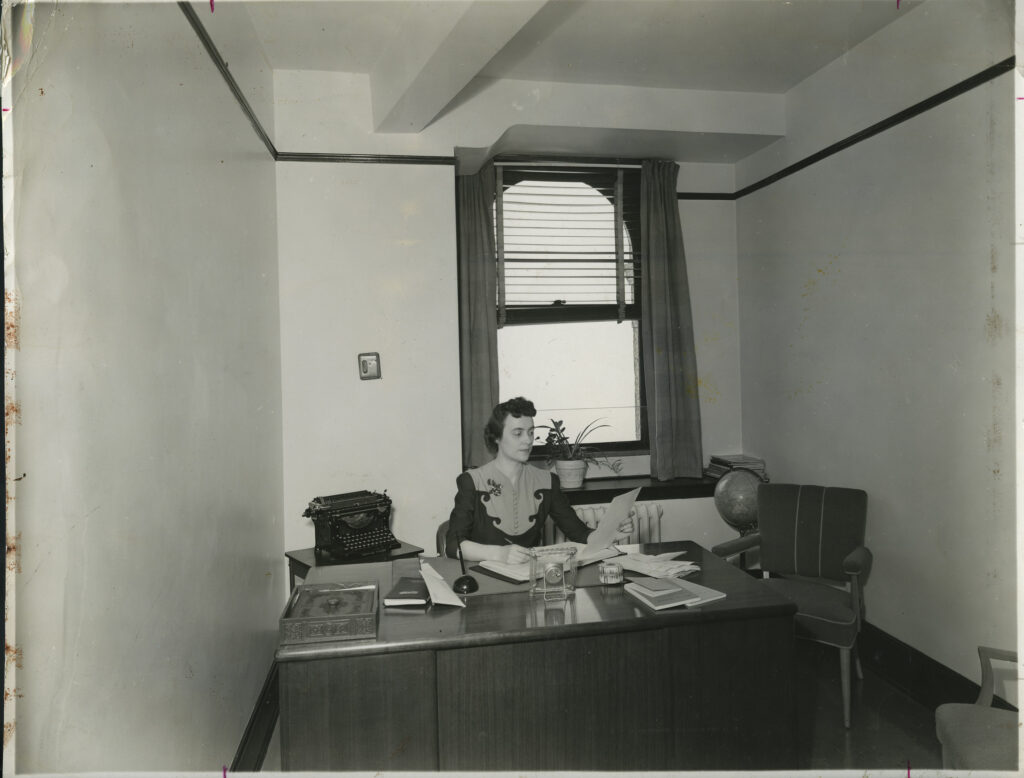
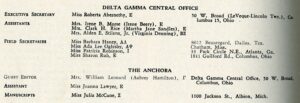
For the first 69 years of its history, Delta Gamma Fraternity was a completely volunteer-run organization. All administrative work from membership records to managing ANCHORA subscriptions was done out of the personal homes of members. One of the longest tenures was held by Leulah Judson Hawley, Lambda-Minnesota. She served from 1915 to 1934 as the Secretary-Editor and is credited with making the earliest effort to centralize recording keeping and support services of the organization. All this work was done out of her own home in Minneapolis, Minnesota. By 1942, it was clear that Delta Gamma needed permanent office space. The first paid staff member, Roberta Abernethy, Epsilon-Ohio State, was hired under the titled Executive Secretary. That same year she and her one assistant, Jean Pierce Dredge, Epsilon-Ohio State, opened the Delta Gamma Central Office in two rented rooms in the American Insurance Union Citadel (now the LeVeque Tower) located in downtown Columbus, Ohio. The office would move twice ending with its current location in a suburb of Columbus. 2022 marks 80 years of Delta Gamma having a dedicated office. This timeline weaves through the history of Executive Offices, the spaces it has occupied, and just a few of the people who have made the work accomplished there possible.
1873: Anna Boyd, Mary Comfort and Eva Webb form the Delta Gamma Fraternity while attending the Lewis School in Oxford, Mississippi.


1915: Leulah Judson Hawley, Lambda-Minnesota served as Secretary-Editor until her passing in 1934. Her home in Minneapolis, for all intents and purposes, served as a “centralized office” for the fraternity. During her tenure membership reaches 9,000.
1924: Fraternity President Nancy Brown Woolett, Phi-Colorado urged that a permanent headquarters be established. In her address to Convention, she talked at length about this issue stating, “I hope we may have time for the consideration formally or informally, on the subject of a National Centralized office. A place where all equipment may be installed, all files kept, and where we may have the services of a full-time secretary.” Going on to note the difficulties in doing such work out of the homes of volunteers she stated, “Many of our sister fraternities have met this problem by establishing a more or less permanent office.”
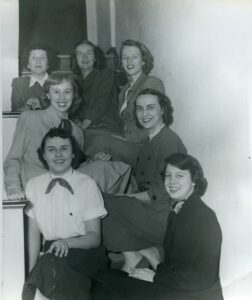
1942: The Convention body voted to establish a Central Office. Roberta Abernethy, Epsilon-Ohio State was hired as the first paid staff member. With her assistant, Jean Peirce Dredge, Epsilon-Ohio State, they opened the Delta Gamma Central Office in two rented rooms at 50 W. Broad Street. Delta Gamma was one of the last women’s Greek organizations to have a national headquarters.


1948: Third room is added to the Central Office due to increasing staff and workload.
1949: Publications department was added to the Central Office. Responsibilities included editing the ANCHORA which had up to this point been done out of the personal home of the editor. This was the precursor of today's marketing and communications department.


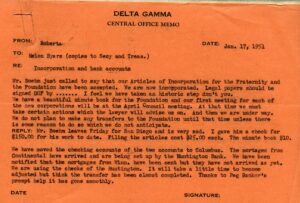
1951: Delta Gamma Foundation is incorporated in Ohio.
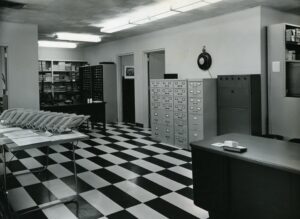
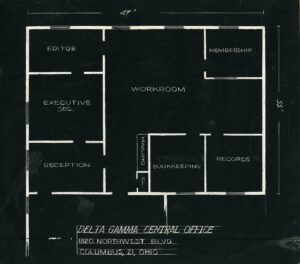
1955: The number of staff and workload increased significantly, and larger office space was needed. Funding had begun to construct a headquarters, in the interim the Central Office moved to 1820 Northwest Boulevard.
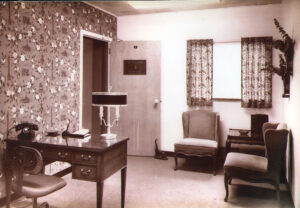
1961: Ground was broken for the construction of the new Delta Gamma headquarters at the corner of Zollinger Road and Riverside Drive. Staff were able to utilize the space by Thanksgiving weekend. When construction was completed, Delta Gamma became the first women’s fraternity to build its own headquarters.


1962: Delta Gamma Executive Offices was dedicated on March 10, with more than 750 people in attendance. Only the first floor was occupied by staff. The second floor was leased to various businesses to help pay off the mortgage.
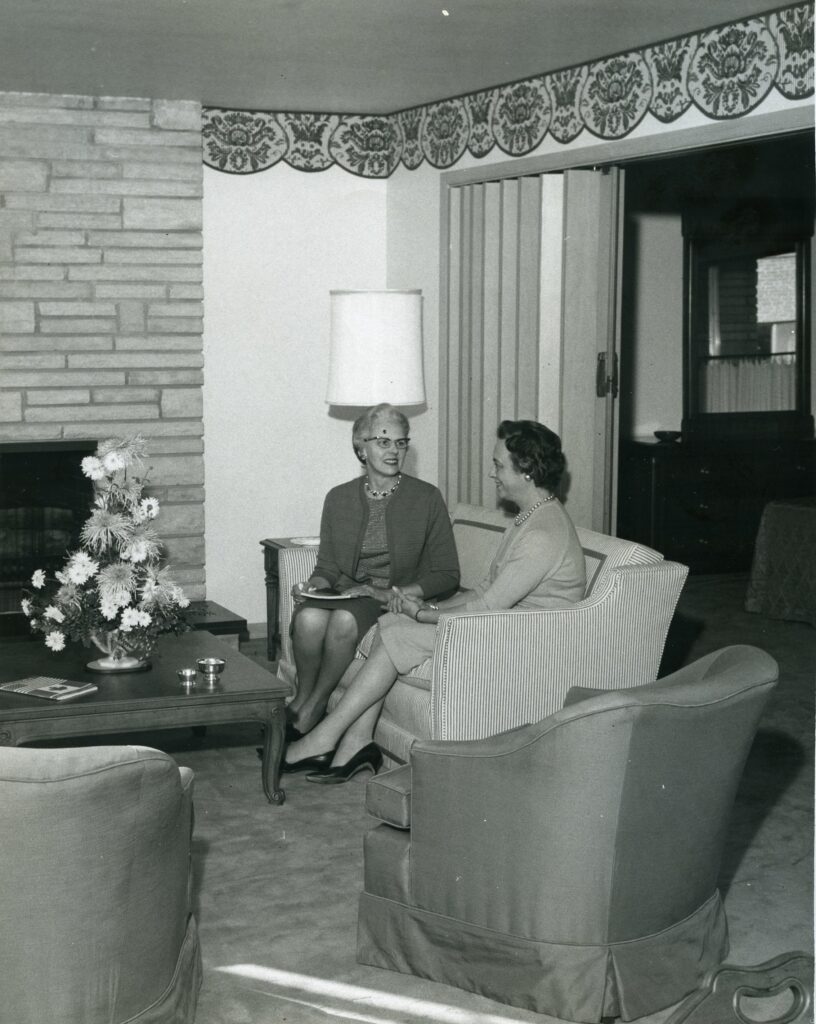
1965 - Portions of the second floor began to be occupied by staff. Part of this space became the archive, managed by Frances Lewis Stevenson, Zeta-Albion. This same year, the renters of the small house on the lot to the south of the main building vacated and Council decided to create a multi-use space for meetings, field secretary trainings and to accommodate overnight guests. It was dubbed the Anchor In.
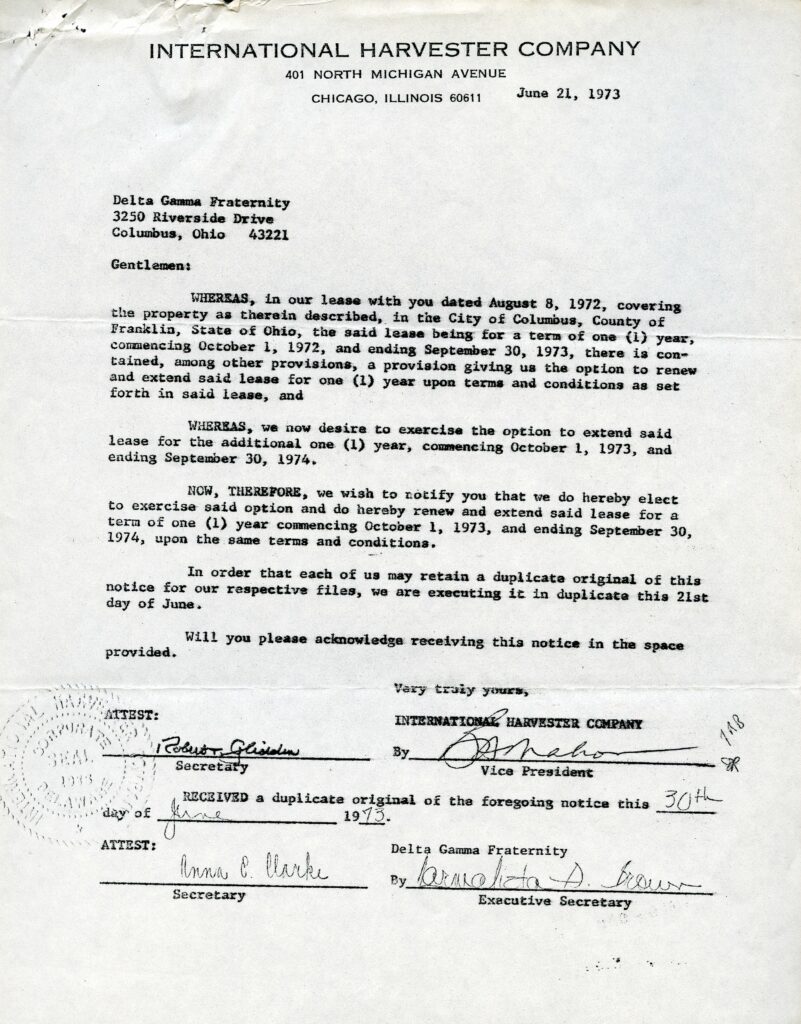
1972 - Less than 10 years after the building dedication the mortgage was completely paid off. In celebration, a mortgage burning was held. This same year, a second phone line was added to Executive Offices and Roberta Abernethy retired.
1973: A ship anchor, on loan from the U.S. Naval History and Heritage Command Curator Branch, was placed on property where it has remained to this day.
1978: The last of renters left Executive Offices and staff now occupied the entire building. The archive space was renamed The Frances Lewis Stevenson Archives.
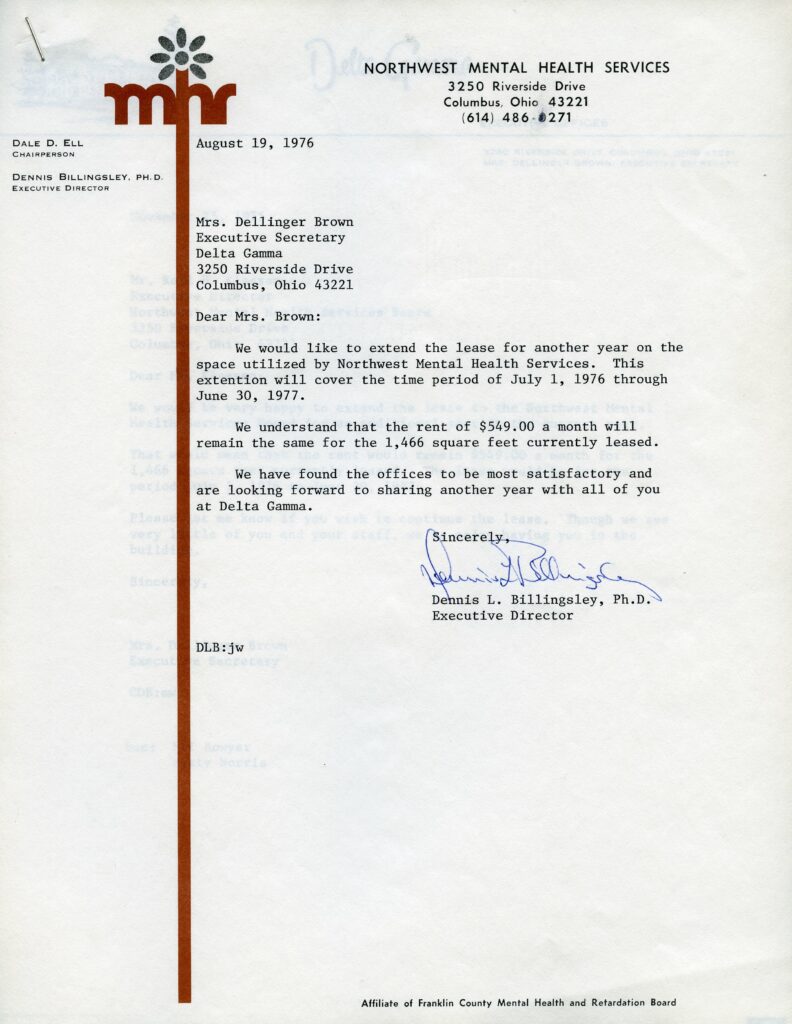
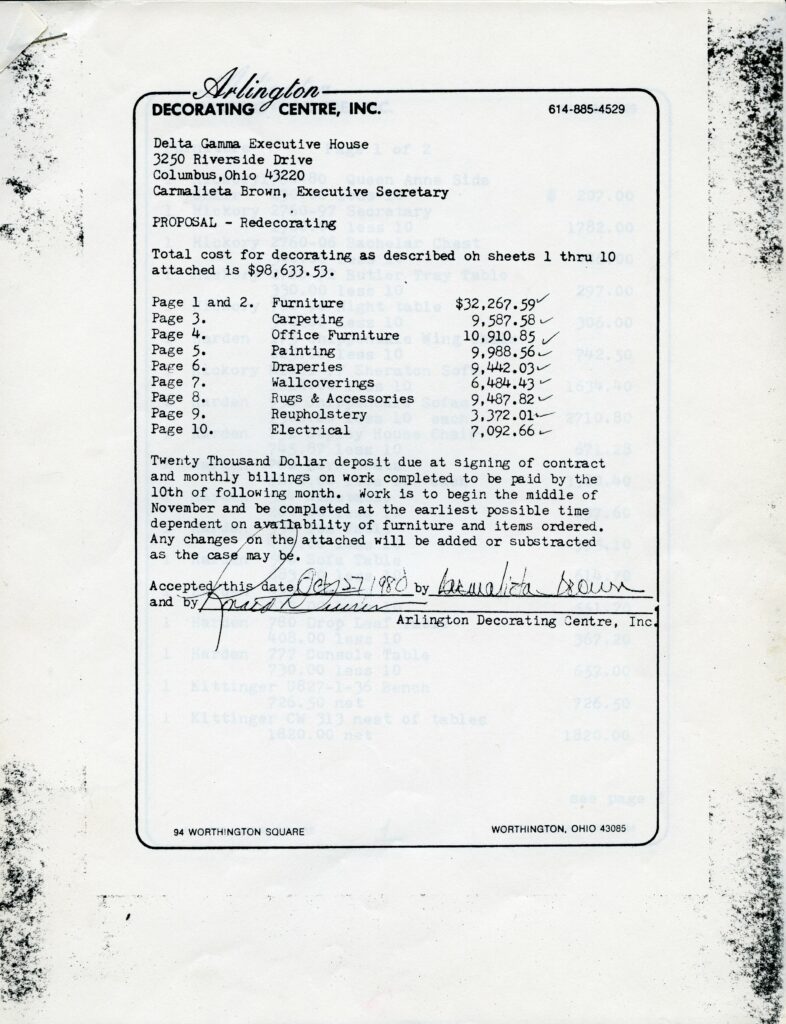
1981: A large-scale redecoration project is undertaken. It included repainting walls, new carpeting and furniture pieces being brought in, as well as work to reupholstering some pieces.


1982: Executive Offices entered the computer age with this Prime 2250 minicomputer and office printer.
1985: Anchor Trader, an in-house product shop, opened occupying much of the basement portion of Executive Offices. It would close in 2007.
1990: The tremendous growth of Delta Gamma meant that the original building was now too small. This led to Project 90, an addition to Executive Offices that would add space for the Foundation. Anchor In was torn down to make way for this expansion.
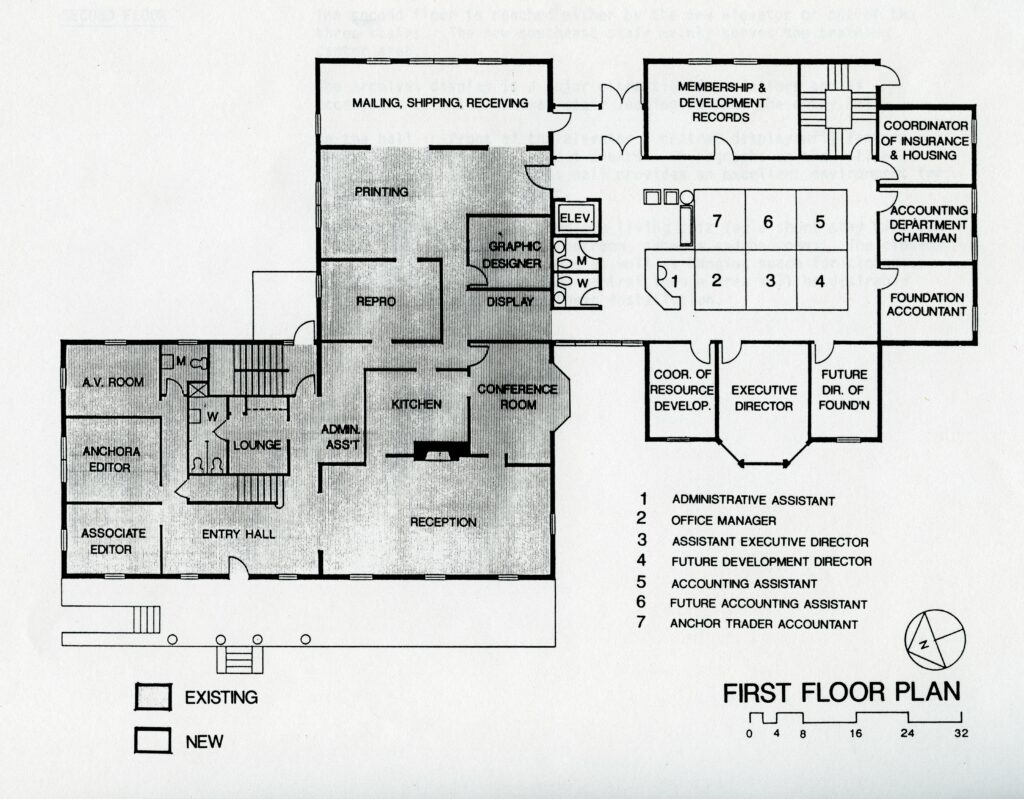
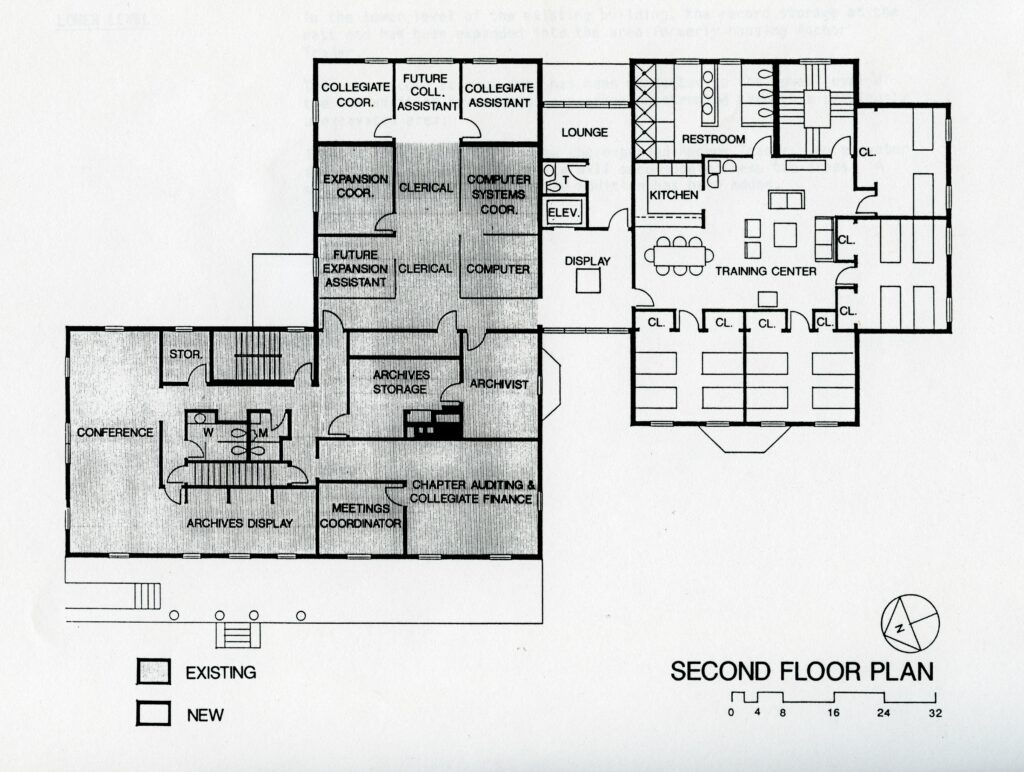
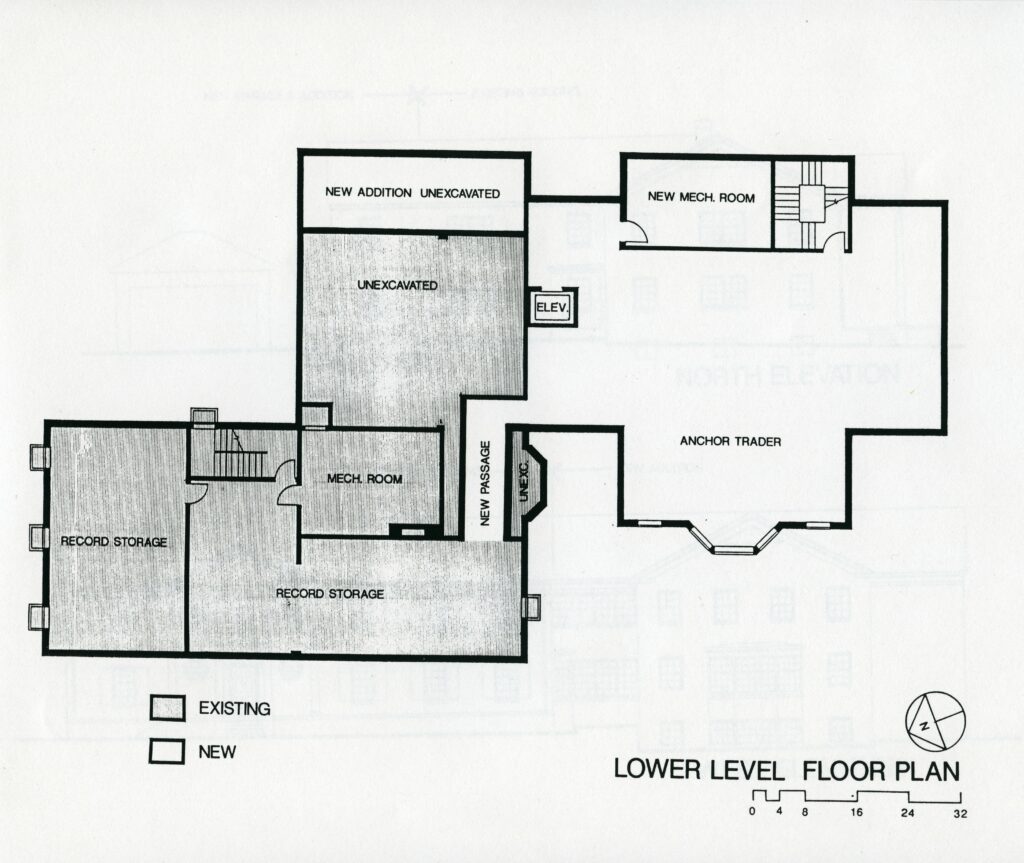

1991: Construction is completed and named The Dorothy Garrett Martin Center. This was in honor of Dorothy Martin, Eta-Akron; and her husband Paul a Phi Delta Theta who had donated the lead gift to build the center. Dedicated on June 23, Delta Gamma became the first women’s fraternity to build a facility dedicated to serving the philanthropic activities of its Foundation.
1995: From 1986 – to 1995 the Delta Gamma Foundation sponsored “The Art of the Eye” exhibit. This visual exhibit featured works of artists with vision impairments. Several pieces were brought in to adorn Executive Offices included the large piece seen in these photos, “Untitled, 1985” by Jennifer Casey.


2011: Beginning in 2007 renovations were done throughout Executive Offices.
2015: The Frances Lewis Stevenson Archives was renovated. New exhibit cases were added in 2017 to display more artifacts.
2022: From the two rented rooms in downtown Columbus to the 16,500 square foot building today, the story of the Delta Gamma Executive Offices reflects the hard work and dedication of countless members.
Staige Davis Hodges, Beta Theta-Duke
Researching stories and gathering images for the sesquicentennial pictorial history, Celebrating 150 Years of Delta Gamma, was fascinating and exhilarating. Little did my co-chair, Maureen McCulloh Hollmeyer, Gamma Rho-Wittenberg, or I know what we would discover. We didn’t even know what we were missing.

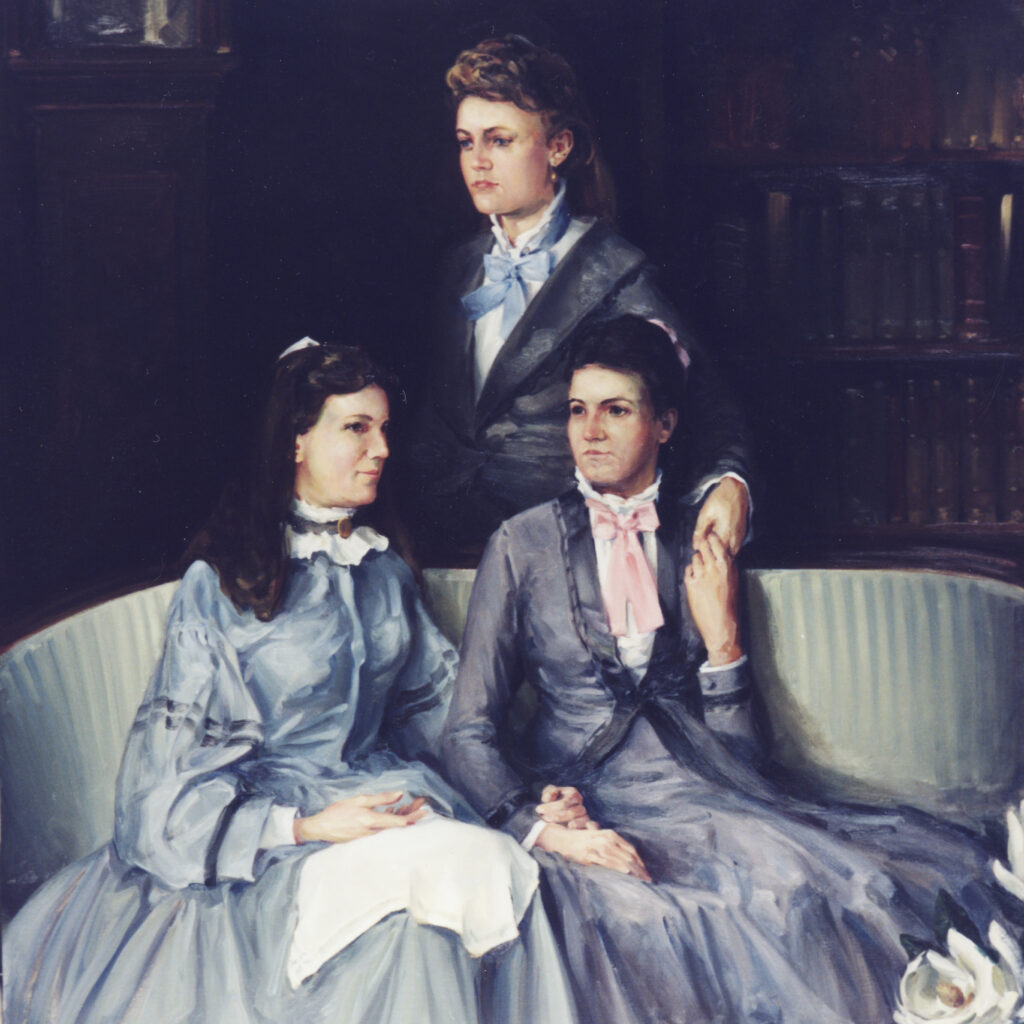
Beautiful, inspiring discoveries included the number of highly educated, motivated members. Many were pioneers in their fields, trailblazers who pursued higher levels of education as doctors, scientists or professors. Helen (Ella) Florence Tyler Whiteley, Phi-Colorado, pictured right, was the first female to earn a degree at the University of Colorado, the only woman out of a class of six. She and her sister, Lillian Tyler Ward, helped found Phi chapter, and both were initiated in 1886. Their father, Clinton Tyler, helped establish the university. Fellow Phi sister Mary Rippon was the first female professor at the University of Colorado, and one of the first women to serve as a university professor in the United States.
One of the most fun parts of the book journey – and it was a journey – was meeting a whole cast of characters, and bringing their stories to life. When a committee member would unearth (no pun intended) a sister, story or photo (those were the most magical) from one of our earliest chapters, we found ourselves plunged back suddenly to the 1870s and 1880s. We became sorority time travelers. Saying it out loud sounds admittedly odd, but that is exactly what our committee became.
One of the most memorable moments was getting an email, and then a text, and quite possibly a phone call (it’s all a bit of a blur, as it happened so fast), from committee member Bunny Wilson Shackelford, Delta Psi-Baylor, when she hit the motherlode. Bunny loved to focus on our earliest chapters, most of which have little to no information. Some chapter rosters only had a handful of members before the chapter closed. Bunny was immersed in Upsilon II-St. Lawrence, active from 1884-1887. There were 12 initiates. We had nothing for the chapter more than an old photograph of the campus in 1887.

Bunny contacted the St. Lawrence University archivist and asked about information on our Delta Gamma chapter from the 1880s. He was perplexed, thinking about our Gamma Omega chapter at St. Lawrence from the 1960s, and replied, “There was not a Delta Gamma chapter here in the 1880s.” Without skipping a beat, Bunny then shared the names of our 12 members gleefully with him. He became a man on a mission. His interns began going through archival boxes. And more boxes. They found ten. Almost the entire roster.
It was imperative we provide Upsilon II with a composite. Merging all the old cabinet card photos into one image gave Upsilon II its first and only composite – 135 years late. In some of their portraits, you can see large, jeweled badges, one with an ornate Upsilon chapter guard pin. We were mesmerized, and so grateful to the St. Lawrence archivist.

If I had a superpower, it would definitely be time travel.

Interested in learning more about Delta Gamma's history? Check out our sesquicentennial anniversary pictorial history book, Celebrating 150 Years of Delta Gamma, 1873-2023. This 96-page limited edition pays homage to our history, including historical vignettes and images, many of which have never been seen before, curated into a masterful, comprehensive treasure trove. Purchase yours here!

By Staige Davis Hodges, Beta Theta-Duke
Delta Gamma has a Fraternity seal. An official seal. An embossed-paper-kind-of-seal, not the kind with flippers. Our seal has gone through numerous iterations during significant events or times in our history, yet many were incorrect due to various turns of events and mistakes which could be seen as a comedy of errors worthy of William Shakespeare himself. From 1877 until 2022, there are seven variations on the seal, many with mistaken founding dates or lettering. The seal appears on chapter charters and other official documents of the Fraternity, so it is important to get our insignia accurate.
To preface this, let it be known that the official Delta Gamma seal created for the Sesquicentennial is indeed correct, and for that we are mighty proud and grateful!

The first Delta Gamma seal appears on the 1877 Constitution and is impressed on the earliest chapter charters. The Greek letter Ψ at the base of the laurel wreath is a nod to Lewis School. The meaning of the letters “C a P” has been lost to time.
Council approved and saw to the development of the seal by a Chicago firm of the design submitted by a Xi-Michigan chapter committee appointed at the 1899 Convention. We have Xi members Katharine Hine and Anna Barnard to thank for the design, which Clara Mulliken, Kappa-Nebraska, presented at the 1903 Convention for official recognition. She moved that the description of the seal be placed in the Fraternity Constitution, which carried, but this was not done until 1962. Interestingly, the 1905 Convention treasurer’s report lists $10.50 as the cost of the seal, and $3.00 for the hand press. For all of you economic inflation types, that is approximately $345/$99 today!
The 1904 version of the seal noted the founding date as 1872, which was the first in the series of over a century of errors. The outer Greek words of the seal read “The Great Seal of Delta Gamma.” The inner Greek words of the seal read “Character and Unity.” Keep your eyes on the letters H in the inner circle.
Sometime in the mid-1900s, the “H” letters in the inner circle were misread as “M” and misprinted, leading to the publication of this seal in the 1945 History and subsequent Constitutions. Additionally, our founding jumped curiously by two years.

A date-corrected seal appeared in 1966, yet the inner words still were incorrect with the letter “M.” And then, our Centennial celebration was upon us, starting in 1971. This special Centennial seal was mass-printed on the cover of the 1971 ANCHORA. The erroneous letter “M” lived on, but was corrected after the publication.

This brings us to the Sesquicentennial. We have seen that, in the years since the Centennial, incorrect versions still appeared, so we knew we needed to get the sesquicentennial seal back to “Character and Unity” as opposed to some Greek gibberish. In planning sesquicentennial special events and commemorative items, the “M vs. H” was at the forefront of our minds. The committee developed a seal worthy of our Founders and the monumental anniversary, as well as the character and unity of our beloved Delta Gamma. Long live the letter H for many reasons.
Interested in learning more about Delta Gamma's history? Check out our sesquicentennial anniversary pictorial history book, Celebrating 150 Years of Delta Gamma, 1873-2023. This 96-page limited edition pays homage to our history, including historical vignettes and images, many of which have never been seen before, curated into a masterful, comprehensive treasure trove. Purchase yours here!
By Diane Hall, Fraternity Archivist

Delta Gamma’s three founders Anna, Eva and Mary formed Delta Gamma Fraternity over the holiday break while attending the Lewis School in 1873. But for most of Delta Gamma’s history, this occasion has been celebrated on March 15 (or the nearest convenient date) rather than in December. This tradition goes back to the 1880s.
In March of 1887 the former ANCHORA Editor Abby Soule, Eta-Akron, made a plea in the publication for a Fraternity-wide reunion day. Eta chapter had been using the date of March 15 (their installation date) as a reunion day and it is likely this was discussed at the 1888 Convention. This date also had the benefit of not conflicting with the winter holiday season. In 1946, Reunion Day was replaced in the Delta Gamma Constitution with Founders Day as a way to remember Delta Gamma’s Founders as the last of the three passed way in 1940. A time for remembrance of history and a reunion with friends, collegiate and alumnae groups will often hold banquets, luncheons or similar events to mark the day. Usual traditions consist of roll call by chapters, talks given by either outside speakers or members, recognition of members for achievement and service and other similar activities.

Join Delta Gammas across the globe as we celebrate 148 years of the Do Good Sisterhood! Planning a Founders Day event? Check out our toolkit to help you host a successful event. Looking for your collegiate chapter history? All chapter histories are now in the library. Find them by searching your chapter name.
Mark your calendars for Tuesday, March 15 at 6 p.m. PT | 9 p.m. ET to join us for a virtual Fraternity-wide celebration. Register here.
By Diane Hall, Fraternity Archivist
Evelyn "Eva" Webb was born on July 5, 1855, into a well-to-do family in Kosciusko, Mississippi. Her cousin Anna Boyd, and their future friend Mary Comfort were born the following January. She was the daughter of Matilda Anna Boyd and Robert Berry Webb. Being economically well-off allowed her family to send her to school in Oxford, Mississippi, where she attended the Lewis School with Anna and Mary. Bad weather plagued the area in the winter of 1873 which prevented the three girls from returning home for the holidays. It was then that they decided to form the Do Good Sisterhood. Eva would spend two years at the Lewis School.

On October 12, 1875, she married the Honorable Samuel L. Dodd, an attorney in Kosciusko. They would have eight children together. Samuel passed away in 1928, Eva outlived him by about six-years, passing away on January 28, 1934. After her passing, her friend Mary wrote of her, “She was a charter member of the Twentieth Century Club and for a long time led the civic work of the club. She also took an active part in the organization of the Mississippi Federation of Women’s Club in 1896. She was a devout and consecrated member of the Presbyterian Church and she lived the religion she professed.”
About Delta Gamma: Delta Gamma Fraternity was founded in 1873 in Oxford, Mississippi at the Lewis School for Girls by three young women: Anna Boyd, Mary Comfort and Eva Webb. Founded before the term sorority was used, our fraternity has since grown into one of the largest international women's organizations with more than 260,000 members, 150 collegiate chapters and 190 alumnae groups.
With Delta Gamma’s founding, Anna, Mary and Eva helped spark a movement to create safe and empowering communities for women on college campuses. We still make that space for each other today, through a culture of belonging, a promise to empower and a commitment to put our purpose into practice.
By Diane Hall, Fraternity Archivist
Mary Eleanor Comfort was born in Kosciusko, Mississippi, on January 22, 1856, the same day as her future friend, Anna Boyd. She was the daughter of Daniel Benjamin Comfort and Eliza Love Durham. Eliza passed at the age of 22 when Mary was still a young child. Daniel would then marry Eliza’s sister. All together, Mary had 12 siblings and they referred to her by the nickname “Mac-Ellen”. Like her friend Anna, Mary’s family was relatively well-off which allowed them to send her to get an education at the Lewis School in Oxford, Mississippi. She would spend three years at this women’s educational institution. It was here during the winter season that poor weather prevented her, Anna, and their friend Eva from returning to their hometown for the holidays. It was then that the three friends decided to form a society “for mutual helpfulness.” They chose the Greek letters Delta and Gamma to stand for do good.

She married Charles H. Leonard in 1880. They relocated to Tennessee where they both worked as teachers. Just a few years later Charles’ health began to decline and the couple moved to Florida where he passed away in 1887. They had three sons, Cecil, William and Herbert. After he husband’s passing Mary returned to Kosciusko where she continued teaching for 16 years. She would live to see her granddaughter initiated as a Delta Gamma. Mary passed away on August 4, 1940, and was remembered fondly in her community by the generation of students she taught.
About Delta Gamma: Delta Gamma Fraternity was founded in 1873 in Oxford, Mississippi at the Lewis School for Girls by three young women: Anna Boyd, Mary Comfort and Eva Webb. Founded before the term sorority was used, our fraternity has since grown into one of the largest international women's organizations with more than 260,000 members, 150 collegiate chapters and 190 alumnae groups.
With Delta Gamma’s founding, Anna, Mary and Eva helped spark a movement to create safe and empowering communities for women on college campuses. We still make that space for each other today, through a culture of belonging, a promise to empower and a commitment to put our purpose into practice.
By Diane Hall, Fraternity Archivist

Anna Rebecca Boyd was born on January 22, 1856, in Kosciusko, Mississippi. She was the daughter of James Madison Boyd and Caroline A. Kennedy Boyd. Her father was a politician and served as a member of the Mississippi legislature, and her mother was a school teacher. The family was relatively well off, allowing Anna to receive a formal education at the Lewis School in Oxford, Mississippi. Luckily her friend Mary Eleanor Comfort and her cousin Eva Webb also attended. Just shy of 18 years old, Anna along with Mary and Eva, founded Delta Gamma Fraternity when bad weather and poor road conditions kept them from traveling back to the hometown for the holiday season in 1873.
Like her own mother, Anna became a school teacher. Upon marrying Daniel A. Ellington in 1882, she gave up her career and the two moved to California. They had four daughters together: Lena b.1883, Harriet b.1884, Caroline b.1886 and Lillian b.1888. Sadly, Daniel would pass away in 1890. A few years after her husband's death, Anna returned to Kosciusko with her children. She placed great importance on educating her daughters. By 1907 her goal was almost completed. Her first two daughters had graduated, one was a sophomore, and the youngest was ready to being college. Anna would not live to see her dream achieved, she passed away on August 12 of that year at the age of 51 years. Remembered for her bright mind and quick wit she was also artistically gifted. She left several sketches one of which you can see here.

About Delta Gamma: Delta Gamma Fraternity was founded in 1873 in Oxford, Mississippi at the Lewis School for Girls by three young women: Anna Boyd, Mary Comfort and Eva Webb. Founded before the term sorority was used, our fraternity has since grown into one of the largest international women's organizations with more than 260,000 members, 150 collegiate chapters and 190 alumnae groups.
With Delta Gamma’s founding, Anna, Mary and Eva helped spark a movement to create safe and empowering communities for women on college campuses. We still make that space for each other today, through a culture of belonging, a promise to empower and a commitment to put our purpose into practice.
Our Collegiate Development Consultant (CDC) program celebrates its 75th anniversary this year. So much has changed in the ways of technology and travel for these women but the fact remains: for 75 years, these women have been an integral part in the development and growth of our sisterhood.
Our 2020-2021 CDC team participated in interviews as normal in February 2020, just before the COVID-19 pandemic changed how the world could operate. In July, the consultants began training virtually, using Zoom for "face-to-face" meetings and finding ways to build camaraderie from afar. The fraternal world was changing rapidly to accommodate pandemic orders and keep members safe, which meant consultants had to quickly become experts in previously uncharted areas of fraternity/sorority life.
The 2020 CDCs have been able to support chapters with virtual recruitment, socially-distanced sisterhood events, and balancing all of the demands on collegians' time (and internet connection). Many 'visits' have been entirely virtual, but some consultants have traveled to the location of our newest chapters to stay for the semester. Despite so much change, the ultimate goal remains the same: support chapter operations, develop the confidence and leadership skills of collegiate officers, and empower Delta Gammas everywhere to live our values and do good.
In the Fall 2020 ANCHORA, we featured the 2020-2021 CDC team and a spotlight on how the job has evolved over its 75 years. In our "Past & Present" story, we talked to current CDC Taylor Johnson, Alpha Omega-Arkansas, and 1970-1971 field secretary Marcia Hunsinger Werremeyer, Mu-Missouri, to get an inside look at the similarities and differences of the role.

What year were you a CDC?
Taylor Johnson: 2019-2020; and I am currently a second-year consultant on the 2020-2021 team
Marcia Hunsinger Werremeyer: 1970-1971
What were the main responsibilities of a CDC?
TJ: Providing consultation and support to collegiate chapters through leadership development, education and guidance. CDCs collaborate with collegiate members, advisers, volunteers, university administrators, and fellow EO staff in their effort to assist chapters in reaching their fullest potential.
MHW: We served as a liaison between EO/Council/Cabinet and collegiate chapters and universities. We problem solved with collegians and reported back to Columbus.
How long was your training?
TJ: A month
MHW: A week or so
What were the main focuses of the training?
TJ: Training begins with an introduction to all departments at EO, who will be integral in assisting us as we work remotely with collegiate chapters, and learning all areas of collegiate chapter functions. Other focuses include recruitment (and retention), as well as sessions to further foster our leadership abilities and knowledge to prepare us to collaborate with guide collegiate chapters.
MHW: Learning best practices, familiarity with CCOM, policies and procedures. There were four of us who came from a variety of DG backgrounds so all needed to be competent in all areas.
What was the best part about being a CDC?
TJ: The best part of being a CDC is working alongside and meeting so many amazing, passionate, and dedicated sisters and friends of the anchor. Oh, and having the opportunity to visit so many new and unique places while do so isn’t bad either!
MHW: Traveling and meeting young women from across North America. While each chapter had its own personality, they all shared similar problems and concerns. Working with involved alumnae set a great example for DG life after college.
What was the hardest part about being a CDC?
TJ: For being a job that involves being constantly surrounded by new people, it can be quite lonesome. As a traveling consultant working with chapters for short periods of time back-to-back I have found that, at times, I have to remind myself to leave time to turn my focus away from work and catch up with friends and family.
MHW: Since we had no means of communication other than letters and long-distance calls, we were pretty much out of touch with our individual friends. It was lonely at times.
What is a travel hack you learned as a CDC?
TJ: TSA precheck and a steamer can and will save your life and/or utilizing Marie Kondo's folding techniques can assist in taking full advantage of space in a suitcase.
MHW: No luggage with wheels in those days so we packed as lightly as possible. Rolling clothes rather than folding minimized the wrinkles.
How many chapters did you visit?
TJ: Last year, I visited 17 chapters in-person and three chapters virtually
MHW: 26?
During those visits, what was the consistent thing that you were really working with chapters?
TJ: Branding, especially the importance social media plays in chapter branding. Anchorbase was also something I regularly worked on with chapter officers.
MHW: How to make sorority life relevant in the lives of collegiate women, [problem solving related to] drugs, uninspired programming, too few women running for chapter offices, ineffective college Panhellenic, recruitment numbers down resulting in unfilled chapter houses and unbalanced budgets were all common areas of concern. (Keep in mind the historical climate: Vietnam War, Kent State shooting, assassinations of Robert Kennedy and Martin Luther King Jr., civil rights, first Earth Day, women's lib, walk on the moon and Woodstock)
We hope you've enjoyed this journey through the last 75 years of the CDC program! You can find blog posts about past decades on the blog homepage, and follow our CDC Instagram account, @deltagammacdcs. If you have questions about the Collegiate Development Consultant program today, email CDCapplications@deltagamma.org.
Applications for the 2021-2022 CDC team are now open! Learn more and apply on our jobs page, and register here for an information session about applying to be a CDC.
~~~~
Today, the Delta Gamma Foundation proudly funds training and programming opportunities through generous gifts to the Foundation, in the areas of social responsibility, health and well-being, and leadership. This includes the Collegiate Development Consultant Program, which is funded in part by the Delta Gamma Foundation!
Delta Gamma’s Collegiate Development Consultant (CDC) program soared into the 21st century, where the advances in technology shaped the role as much as it shaped the world. Despite the many changes to come, many of the program staples stayed the same: like making memories living and training in the Martin Center, learning from staff, Leadership and members of Council.
2006-2007 CDC Emily Burris Hester recalls her experience, “Training was truly one of the best experiences. Living in the Martin Center, “commuting to work” walking from our bedrooms to the training table. Snacks galore! Those weeks helped shape our incredible team. I remember Tracey [Doebling Williams, now Fraternity Executive Director] telling us, ‘You’ll get tired of eating as a big group of 10,’ yet somehow it never got old to us! Most of our training was done by our fearless leaders, Tracey Williams and Beth Searcy. These women set high expectations.”
Emily added, “We learned from incredible Delta Gamma sisters – truly ones I consider giants of our great Fraternity. These women helped connect us to the bigger picture of Delta Gamma and get a full understanding of what we needed to know before life on the road. I have this belief that people who were in Fraternity Leadership roles when you first came into being involved at a high level remain forever in your head in that role as your marker for Fraternity Leadership. Shari Malone, Fraternity President at the time, spending training with us is among my most cherished time in DG. And the incredible teams who came in each weekend hold special places in my heart.”

While technology was rapidly progressing, CDC in the early 2000s still mailed their information to chapters prior to their arrival. They were provided a cabbage case containing file folders with policies and educational resources. Upon landing, a CDC was picked up from the airport by a member from the chapter – hoping that their car was big enough for her massive cabbage case and luggage – and taken to where she would be staying. Typically, CDCs would stay either in the chapter house, a dorm room, apartment or hotel.
2003 saw the inauguration of the Baynard named consultant, started in memory of Mildred Moyer Baynard, Kappa-Nebraska. Since 2003, Mildred’s trust has provided the funds for a consultant to work with one of Delta Gamma’s newest chapters to give a little extra special attention.
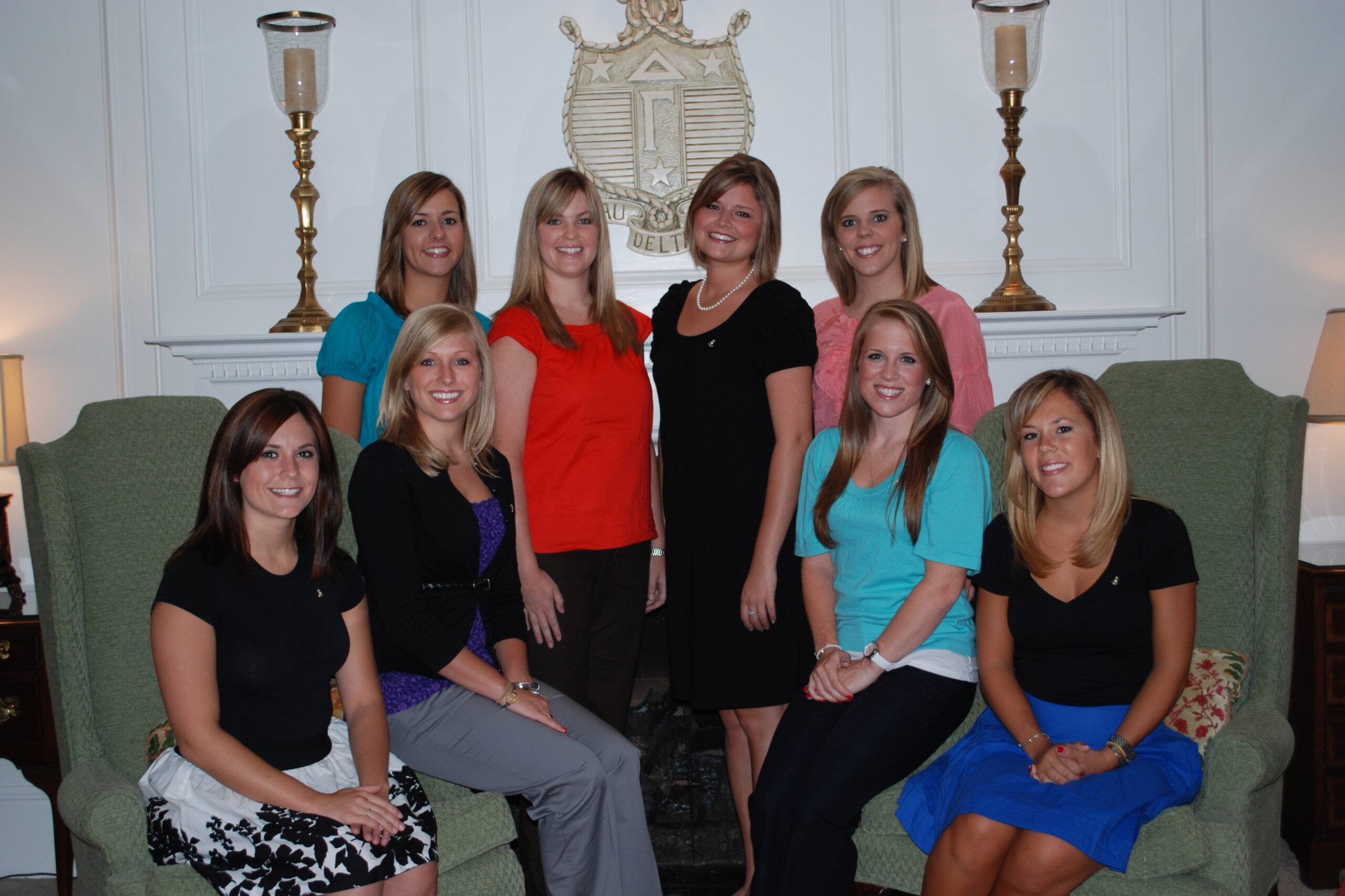
Many CDCs spent their visits educating chapters on anti-hazing policies as well as teaching financial management and recruitment best-practices. During this period a new phenomenon arose: social media. CDCs and chapter members learned how to navigate it together.
Melissa Less Eckenrode recounts as a CDC in 2004-2005, “Facebook STARTED the year I was on the road ... we had no idea what was to come with that, but I do remember some of the chapter members at Arizona State introducing me to it! So social media was just starting to pick up.”

As the CDC program entered the 2010s, consultants traded cases full of documents for laptops and smart phones, able to type up their reports on the go and email them to the chapter, Executive Offices and Leadership. Even the ability for the CDC to text the collegian picking her up from the airport or taking her to dinner was a game-changer. These changes also meant extensive training on new recruitment software, database management, chapter budgeting software and how to utilize chapter websites and social media platforms for marketing and promotion.
The decade brought numerous establishment opportunities, reaching a peak in 2017 when the largest team in the history of the program, 22 consultants, made it possible to oversee 4 establishments, several new chapters, and an increased number of recruitment visits for all chapters.

"For the five weeks of training, we crammed 8 tables, 22 chairs, a projector and screen into the formal living room at Executive Offices. The floor was a dangerous web of laptop charging cables and after two days the room was so warm we had to fill the last remaining bit of floor space with as many oscillating fans as would fit!" shared 2017-2018 CDC Alexa Ruestman. "Each day of training involved someone leading an activity or game, which, for 22 women in such a small space, would leave us laughing and chatting so loudly that Tracey would have to slide open her door to shush us!"
Collegiate officers prepared visit schedules in spreadsheets or Google calendars, and consultants usually had their phone and laptop in hand all day as they hopped from coffee shop to chapter house to Student Affairs office. Many meetings were shaped by the conversations CDCs had been having for decades: recruitment, financial management, preventing hazing behaviors. But new areas of chapter focus lead to new ways the consultants could offer support. "Big trends while I was a CDC included mental health, confidence in young women, social media, and inclusion," shared 2018-2020 CDC Jordan Rawlinson. "These issues were approached through the DG Dialogues program, as well as 1:1 conversations, group meetings and facilitating workshops."
It's the confidence, adaptability and creative thinking from these meeting and conversations that many former CDCs credit for the real-world skills they gained on the road. CDC Kati Wechsler shared: "Being a CDC has given me so many skills that will benefit me both in life and in my future career as an occupational therapist. In my first semester of graduate school, I had a practice session with a patient in which I planned a 30 minute exercise. My professor commented on how easily I maintained composure and engaged my patient in conversation that allowed me to learn about their interests. Conversation is a huge part of building rapport, and the confidence I gained from being a CDC in my ability to meet new people and form a connection is invaluable. The knowledge that I can walk into any situation and make the best of it is the most important thing I learned from CDC life."
In the next post, we'll be featuring what CDC life has been like in 2020 from the perspective of our current team of consultants! To learn more about applications for the 2021-2022 CDC team, visit our Jobs page!
Today, the Delta Gamma Foundation proudly funds training and programming opportunities through generous gifts to the Foundation, in the areas of social responsibility, health and well-being, and leadership. This includes the Collegiate Development Consultant Program, which is funded in part by the Delta Gamma Foundation!